

How Ardent Health uses joint ventures to grow
September 8, 2026
Private equity’s expansion into healthcare is increasingly happening through joint ventures with nonprofit health systems rather than traditional acquisitions. Our recent report, Private equity’s joint venture takeover of nonprofit healthcare, examines this growing ownership model and the questions it raises for patients, healthcare workers, and regulators.
An example we highlight is Ardent Health, a private equity-backed hospital operator that has used joint ventures with nonprofit and academic health systems as a key strategy for expansion.
Ardent Health describes itself as a “leading provider of healthcare in growing mid-sized urban communities across the U.S.,” delivering care through a system of 30 acute care hospitals, more than 280 sites of care, and over 2,000 providers across Texas, Oklahoma, New Mexico, New Jersey, Idaho, and Kansas.[1]
Equity Group Investments (EGI) is the majority owner of Ardent Health.[2] EGI partnered with Ventas, a healthcare real estate investment trust, to acquire Ardent in 2015.[3] Through this transaction, Ventas took ownership of Ardent’s real estate, and EGI and other capital partners acquired the operations and entered into a long term master lease agreement with Ventas.[4] EGI holds four seats on Ardent’s board, including the chair.[5] Ardent went public through an initial public offering (IPO) in June 2024 for total gross proceeds of about 192 million.[6]
Joint venture structures
Ardent Health has partnered with nonprofit systems and academic medical centers in joint ventures in which, “these partners bring their strong brand names and access to clinical specialists while Ardent provides best practices around community hospital operations the nonprofits may lack,” as Fierce Healthcare described in a March 2025 article.[7] The joint ventures are, according to Ardent’s 2024 annual report to stockholders, “designed to capitalize on the unique localized opportunities presented to us in each market” though each is structured such that Ardent has a majority ownership interest — typically 60 to 80% — with a shared governance structure, Ardent receives a management fee, and allows for “quarterly distribution of excess cash beyond required capital needs” in order to provide a consistent flow of cash from the operations.[8] In its annual report published in March 2026 for the fiscal year ending in December 2025, Ardent wrote that its joint venture partners “offer us significant advantages, including expanded access points, clinical talent availability, local brand recognition, and scale that enable us to accelerate market penetration.”[9] Ardent described the benefits of the joint venture model in this way:
“Our joint venture model provides us the ability to use the joint venture partners’ payer network, regional presence and brand, expertise and managed care contracting capabilities. We believe our joint venture model is attractive to joint venture partners because of our operational expertise, strong local management teams, commitment to quality patient care and the expanded footprint for the joint venture partner. This joint venture strategy also provides an avenue for accretive growth by creating opportunities to acquire hospitals that would be more competitive if part of a larger network. We believe that this strategy not only makes us a leader in a majority of our markets, but also contributes to our ability to improve the quality of care for our patients, increase operational efficiencies and drive earnings growth in our existing and newly acquired markets.”[10]
In a 2018 SEC filing, Ardent described the following benefits of its joint venture partnerships:
- “an ability to utilize our joint venture partners’ goodwill and name recognition in the community;
- well-known networks and efficient, leading community hospital settings that attract physicians to our health systems;
- enhanced clinician satisfaction, retention and staffing capabilities;
- an enhanced ability for the partnered facilities to be reimbursed fairly due to established networks, regional presence and managed care contracting infrastructure and expertise;
- improved group purchasing organization terms due to scale;
- operating efficiencies from improved management and collection of patient service revenues;
- an effective voice in the local and state regulatory process through not-for-profit leadership; and
- improved quality of care at partnered hospitals and availability of quality referral hospital options for critical cases due to clinical integration.”[11]
When targeting a potential joint partner, Ardent seeks to acquire systems that “are, or have the potential to become, market leading regional health systems in urban markets with favorable demographic trends.”[12] Ardent says that it often acquires “underperforming or undermanaged facilities where we can implement our best practices and seek to realize significant operating efficiencies from improved management and collection of patient service revenues, greater purchasing power due to our scale, facility-level productivity improvements, access to a quality information technology system at a better cost, managed care contracting expertise and an in-network payer strategy.”[13]
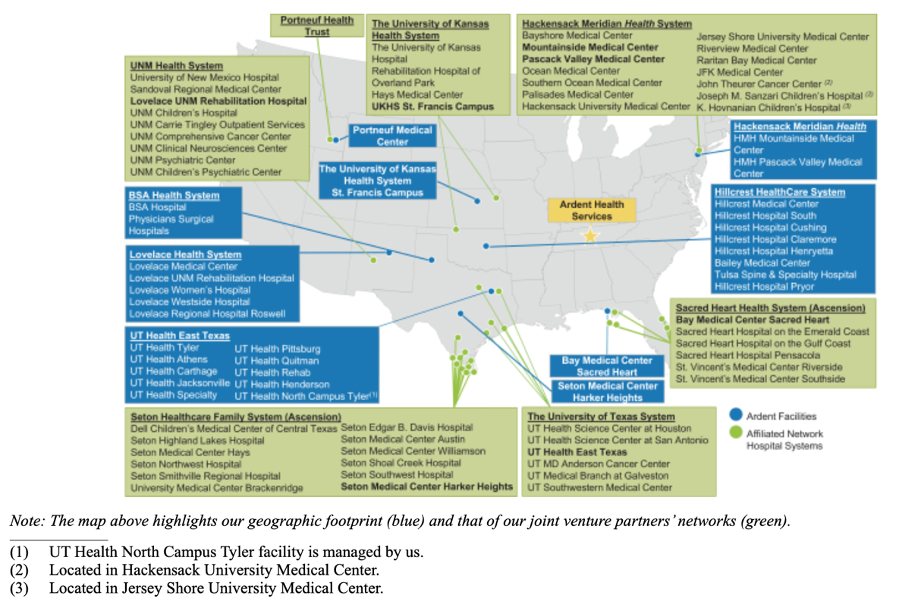
Another benefit of the joint partnership strategy appears to be access to the joint venture partners’ networks. In a December 2018 SEC filing, Ardent said, “we have built expansive networks of patient access points, healthcare specialists and hospitals that provide a comprehensive continuum of inpatient and outpatient medical services,” and included a map of the company’s geographic footprint and that of its joint venture partners’ networks.[14] The map below shows both hospitals owned by Ardent’s joint ventures (in blue and bolded in green boxes), as well as the networks associated with the joint ventures (in green) where patients could be referred.
Organizational structure as of July 2024[15]
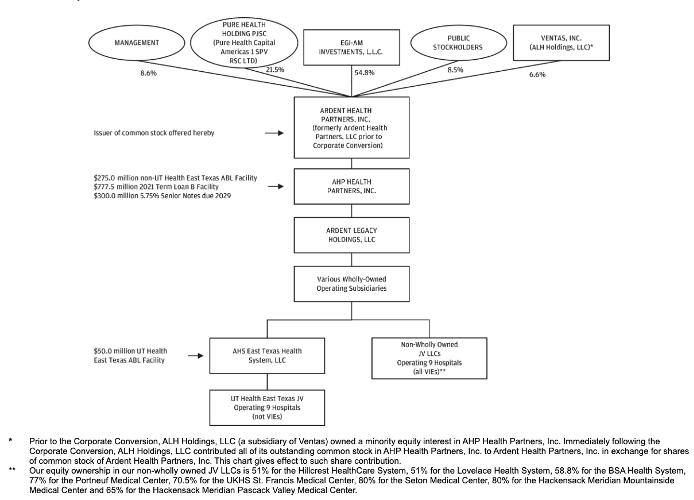
Ardent’s joint ventures as of July 2024[16]
| Health system | Location of health system’s headquarters | Number of operated hospitals | Number of joint venture-operated hospitals | Ardent-owned hospitals | Leased hospitals | Ardent’s joint venture equity ownership |
| UT Health East Texas | Tyler, TX | 9 | 8 | 7 | 1 (Ventas) | 70% |
| Hillcrest HealthCare System | Tulsa, OK | 8 | 1 | 0 | 8 (four from Ventas, three from county, one from JV partner) | 51% |
| Lovelace Health System | Albuquerque, NM | 5 | 1 | 0 | 5 (Ventas) | 51% |
| Hackensack Meridian Medical Centers | Montclair/Westwood, NJ | 2 | 2 | 1 | 1 (MPT) | 80% / 65% |
| BSA Health System | Amarillo, TX | 3 | 2 | 2 | 1 (Ventas) | 58.8% |
| Portneuf Medical Center | Pocatello, ID | 1 | 1 | 1 | 0 | 77% |
| UKHS St. Francis Medical Center | Topeka, KS | 1 | 1 | 1 | 0 | 70.5% |
| Seton Medical Center Harker Heights | Killeen, TX | 1 | 1 | 1 | 0 | 80% |
Ardent Health’s joint ventures are structured to divide profits, losses, distributions, and director responsibilities between the parties based on ownership interest. Ardent’s 2026 10-K explains that the joint venture’s “losses and cash distributions are distributed between us and our partners pro rata based upon the respective ownership interest in the JV.”[17] In terms of governance, the joint venture has two groups of directors, one appointed by Ardent, and the other appointed by the joint venture partner.[18]
Of the 30 acute care hospitals Ardent operates, 12 are leased from real estate investment trusts Medical Properties Trust (MPT) and Ventas, including several joint venture-owned hospitals.[19] As discussed in the Lifepoint case study, selling the real estate of a hospital to a third party which then leases it back to the operator can generate short-term payouts while locking the operator into a lease agreement indefinitely.[20]
MPT owns the real estate of Hackensack Meridian Mountainside Medical Center, a hospital jointly owned by Hackensack Meridian Health.[21] Ventas acquired ownership of ten of Ardent’s real estate holdings in exchange for a $1.4 billion payment from Ventas and an agreement from Ardent to lease the acquired real estate back from Ventas.[22] The joint venture-owned hospitals involved in the Ventas sale-leaseback agreement include UT Health East Texas, Hillcrest HealthCare System, Lovelace Health System, and BSA Health System.[23]
Joint venture-owned Ardent hospitals with sale-leaseback agreements
| Hospital | REIT owner |
| Hackensack Meridian Mountainside Medical Center | Medical Properties Trust |
| Lovelace UNM Rehabilitation Hospital | Ventas |
| UT Health East Texas Rehabilitation Hospital | Ventas |
| BSA Hospital | Ventas |
Joint ventures as a strategy for growth
Ardent Health describes joint ventures as a valuable tactic for growth: “An important part of our business strategy includes growth by executing strategic opportunities such as JVs and acquisitions, including the acquisition of healthcare systems, individual hospitals, outpatient clinics, physician groups and other ancillary healthcare businesses… If we are unable to complete identified acquisitions and JVs on acceptable terms, it is unlikely that we will sustain the historical growth rates of our business and our profitability may be adversely affected if we cannot continue to scale our platform through such acquisitions.”[24]
Ardent seems to see continued growth opportunities through joint ventures. A March 2025 article in Fierce Healthcare explained, “Citing financial headwinds and likely detrimental policy shifts for nonprofit health systems, executives said they are ‘encouraged by the opportunity’ to expand Ardent’s existing joint venture partnerships and potentially strike up some new deals this year.”[25] In the article, Chief Financial Officer Alfred Lumsdaine said, “About 40% of hospitals are losing money, and with some of the impending potential changes in regulatory policy, that could exacerbate that situation for a lot of nonprofit hospitals. We think we have a proven track record … working with academics and the needs that they may have. There’s already been some cuts to [National Institutes of Health] funding, they’re going to have to reprioritize where they spend their capital. We think we’re going to be a great opportunity for systems like that.”[26]
| Year | Total revenue | Revenue from JVs and VIEs | Percent revenue from JVs and VIEs |
| 2024 | $5.9 billion[30] | $1.7 billion[31] | 28% |
| 2025 | $6.3 billion[32] | $1.8 billion[33] | 28% |
Given that 60% of Ardent’s hospitals are owned through joint ventures, it is unclear why only 28% of Ardent’s reported revenue comes from joint ventures. Ardent reports that it has management services agreements with its VIEs.[34] The discrepancy between the revenue reportedly attributed to joint ventures and VIEs and the expected revenue from the ventures may be due to management fees Ardent collects but does not attribute to joint ventures for accounting purposes.
Unique arrangement: University of Texas Health Science Center at Tyler
Ardent’s joint venture with the University of Texas Health Science Center at Tyler (UTHSCT) is different from its other joint ventures in that each organization retained its own assets rather than contributing them to the joint venture.[35] The joint venture agrees to share the earnings of the eight hospitals and related facilities on a basis of 70% to Ardent and 30% to UTHSCT.[36] The joint venture is governed by a board, which approves matters through block voting.[37]
The UTHSCT joint venture was formed through relationships between East Texas Medical Center Regional Healthcare System (ETMC) and the University of Texas Science Health Center at Tyler, along with Ardent Health.[38] According to Ardent’s website, in February 2017, ETMC began to search for a strategic partner to acquire its system due to “struggling with substantial debt and ongoing operational issues.”[39] UTHSCT was facing an “increasingly consolidated market” and recognized the need to grow, and started seeking a partner.[40] It was important to UTSCT to maintain its nonprofit status and state ownership of its hospital.[41] “Maintaining significant equity and governance in the new combined enterprise, and expanding access to clinical educational opportunities throughout East Texas were also clear priorities.” For ETMC, the partnership offered hospital operations support and access to capital.[42] The joint venture was formalized in March 2018, and Ardent and UTHSCT had significant stakes and governance.[43] Ardent managed operations and committed to invest $125 over the first five years to “stabilize the health system and provide needed resources.”[44]
In its 2018 S-1 Form, Ardent described what it saw as the success of the UTHSCT joint venture:
“In March 2018, we successfully formed a joint venture with UTHSCT and acquired substantially all of the assets and operations of ETMC. The joint venture, UT Health East Texas, includes 10 hospitals, more than 50 clinics, 13 outpatient rehab clinics, home health services that cover 40 counties and over 300 area providers. As part of the acquisition we have been able to identify and achieve significant synergy opportunities through operational improvements. For example, we have realized approximately $12.2 million in operating synergies from the ETMC Acquisition since March 1, 2018 through June 30, 2018, and we expect to realize additional synergies of approximately $34 million by the end of 2019 as a result of renegotiated professional services and supply chain contracts and rate increases from Medicare and managed care contracts…We believe this strategic partnership positions us well for future acquisitions and other growth opportunities, such as graduate medical education expansion through residency programs with The University of Texas System.”[45]
[1] Ardent Health, Inc., “Form 10-K,” March 16, 2026, https://www.sec.gov/Archives/edgar/data/1756655/000162828026018174/ardt-20251231.htm.
[2] “Pure Health Completes Transaction with Equity Group Investments for Acquiring Stake in Ardent Health Services,” accessed April 2, 2026, https://www.businesswire.com/news/home/20230501005788/en/Pure-Health-Completes-Transaction-with-Equity-Group-Investments-for-Acquiring-Stake-in-Ardent-Health-Services.
[3] Equity Group Investments, “Ardent Health Services,” Case study, June 17, 2021, https://www.egizell.com/wp-content/uploads/2021/07/Ardent-financial-restructuring-and-growth-platform-healthcare.pdf.
[4] Equity Group Investments, “Ardent Health Services.”
[5] Equity Group Investments, “Ardent Health Services.”
[6] Amy Or, “Equity Group-Backed Ardent Health Files for IPO in Second Try,” Bloomberg.Com, June 21, 2024, https://www.bloomberg.com/news/articles/2024-06-21/equity-group-backed-ardent-health-files-for-ipo-in-second-try; “Ardent Health Announces Closing of Its Initial Public Offering | Ardent Health,” accessed April 2, 2026, https://ardenthealth.com/our-stories/ardent-health-announces-closing-its-initial-public-offering.
[7] Dave Muoio, “Ardent Health Sees Nonprofits’ Headwinds as Growth Opportunity,” March 20, 2025, https://www.fiercehealthcare.com/providers/ardent-health-execs-eye-outpatient-growth-see-nonprofits-headwinds-growth-opportunity.
[8] “Form S-1,” SEC, December 4, 2018, https://www.sec.gov/Archives/edgar/data/1756655/000119312518342132/d658879ds1.htm. Pg. 7
[9] Ardent Health, Inc., “Form 10-K.”
[10] “Form S-1.” Pg. 7
[11] “Form S-1.” Pg. 7
[12] “Form S-1.” Pg. 108
[13] “Form S-1.” Pg. 108
[14] Ardent Health Partners, “Form S-1,” SEC, 2018, https://www.sec.gov/Archives/edgar/data/1756655/000095012318010264/filename1.htm. Pg. 6
[15] “Ardent Health Partners Form 424(B)(4),” July 17, 2024, https://www.sec.gov/Archives/edgar/data/1756655/000119312524181092/d754933d424b4.htm.
[16] “Ardent Health Partners Form 424(B)(4).” Pg. 5
[17] Ardent Health, Inc., “Form 10-K.”
[18] Ardent Health, Inc., “Form 10-K.”
[19]Ardent Health, Inc., “Ardent Health 10-Q March 2026,” SEC, May 7, 2026, https://www.sec.gov/Archives/edgar/data/1756655/000162828026031299/ardt-20260331.htm.
[20] “When Private Equity Sees Hospitals as Land, Not Care,” Health Leaders Media, Jul 7, 2025, https://www.healthleadersmedia.com/payer/when-private-equity-sees-hospitals-land-not-care.
[21]Ardent Health, Inc., “Ardent Health 10-Q March 2026.” Pg. 34.
[22]Ardent Health, Inc., “Ardent Health 10-Q March 2026.” Pg. 12.
[23] “Ardent Health Partners Form 424(B)(4).” Pg. 5
[24] “Ardent Health Partners Form 424(B)(4).”
[25] Muoio, “Ardent Health Sees Nonprofits’ Headwinds as Growth Opportunity.”
[26] Muoio, “Ardent Health Sees Nonprofits’ Headwinds as Growth Opportunity.”
[27] Ardent Health, Inc., “Form 10-K.”
[28] Ardent Health, Inc., “Form 10-K.”
[29] Ardent Health, Inc., “Form 10-K.” Pg. 36 and 66
[30] Ardent Health, Inc., “Form 10-K.” Pg. 66
[31] Ardent Health, Inc., “Form 10-K.” Pg. 36
[32] Ardent Health, Inc., “Form 10-K.” Pg. 66
[33] Ardent Health, Inc., “Form 10-K.” Pg. 36
[34]Ardent Health, Inc., “Ardent Health 10-Q March 2026.” Pg. 7.
[35] “Ardent Health Partners Form 424(B)(4).” Pg. 131
[36] “Ardent Health Partners Form 424(B)(4).” Pg. 131
[37] “Ardent Health Partners Form 424(B)(4).” Pg. 131
[38] “Case Study: UT Health East Texas,” Ardent Health, n.d., accessed August 29, 2026, https://ardenthealth.com/sites/default/files/2024-06/Ardent_East_Texas_Case_Study_2023.pdf.
[39] “Case Study: UT Health East Texas.”
[40] “Case Study: UT Health East Texas.”
[41] “Case Study: UT Health East Texas.”
[42] “Case Study: UT Health East Texas.”
[43] “Case Study: UT Health East Texas.”
[44] “Case Study: UT Health East Texas.”
[45] Ardent Health Partners, “Form S-1.” Pg. 11