
Brookfield’s aggressive buying spree meets tenant resistance
June 25, 2026
The private equity firm Brookfield Asset Management has gotten back into the housing market in a big way recently, a notable change from just a few years before, when Brookfield unloaded $10 billion of US rental housing in a six-month period in 2021-2022.[1]
The company has acquired thousands of rental units in the last two years throughout Europe and the U.S., including a 7,300-unit portfolio from Starwood Capital, concentrated in Florida and Texas and 4,100 unitsfrom Blackstone in Las Vegas, Phoenix, Columbus, and Charlotte. Brookfield currently owns over 200 apartment buildings in the U.S. with about 60,000 total apartment units, according to CoStar.
Brookfield is in the process of acquiring a manufactured home park owner with 77,000 home sites. In May 2026, Brookfield’s CEO told analysts on a conference call that the private equity firm is expecting to do $20 billion of real estate deals in a two-month period.
Brookfield’s acquisitions have been met with resistance from tenants who refuse to be priced out of their homes. They are demanding safe housing and to be treated with respect.
Madrid
Earlier this year, Brookfield bought 5,000 rental apartment units across 47 properties in Madrid from another private equity company, Blackstone, for $1.4 billion.
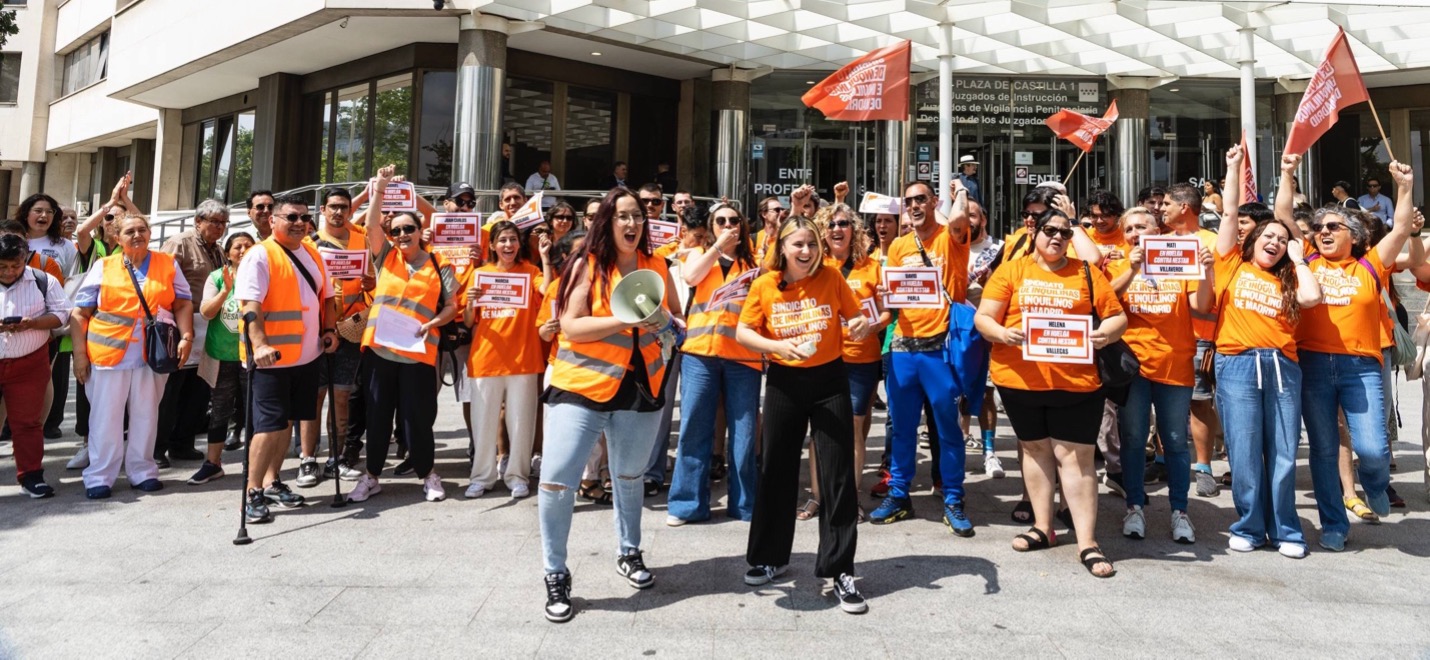
Tenants of these properties are organized with the Sindicato de Inquilinas de Madrid/ Madrid Tenants Union and have vowed that they will not accept rent increases or evictions through non-renewal of leases. In March, tenants occupied the lobby of the Marriott Princesa Plaza Hotel, which is owned by Brookfield, chanting “Out with the vultures” and “Homes to live in, not for Brookfield.”
Tenants at these properties had a long-standing fight with Blackstone, which had tried to impose massive rent increases. In 2021, after months of organizing and resistance, the tenants union forced Blackstone to the bargaining table. The union was able to win new leases without large rent increases with a seven-year term, plus a three-year extension, for many of the tenants.
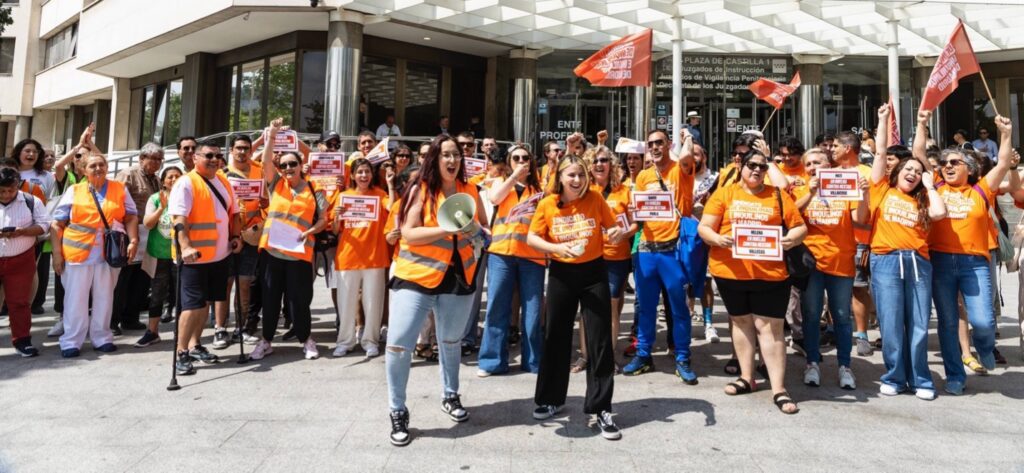
Members of the Sindicato de Inqulinas de Madrid/ Madrid Tenants Union
Yes! Communities
In the U.S., Brookfield is in the process of acquiring Yes Communities, which owns about 270 manufactured home parks with 77,000 home sites. Residents of Yes Communities across four states and advocacy groups MHAction and the Private Equity Stakeholder Project published an open letter to Brookfield, urging the company to commit to a basic set of standards and resident protections. Since then, residents have been meeting with Brookfield’s investors and speaking at meetings of pension funds that are invested with Brookfield, such as the Minnesota State Board of Investment, Texas Teachers Retirement System, South Dakota Investment Council, the New York City Employees Retirement System, and the University of California.
At a University of California Regents meeting, residents said that they want to know how Brookfield will address the problems they’ve been experiencing. Anna Allen, a resident of Yes’s Fremont Grove in Illinois, said, “Yes Communities is making our lives miserable,” and told the regents about the large increases in lot rent she has to pay. Abbie Pedrotte, a resident of Yes’s Lawndale Estates in Michigan, told the regents how Yes’s practices have negatively impacted her life. “Their constantly raising rent prices puts myself and my other fixed-income neighbors at serious risk of homelessness. The rent just keeps going up, but no improvements have been made.” Abbie added that in Yes’s view, “we aren’t human beings, we’re mere dollar signs, and neither our rights nor quality of life seems to matter at all.”
San Francisco
Brookfield paid $460 million for a 2,100-unit portfolio in San Francisco that had been owned by Veritas.[2]The Housing Rights Committee of San Francisco (HRCSF) had been organizing tenants at Veritas properties for years and continued its fight against Brookfield as the new owners.
Immigrant tenants at one of the properties, 434 Leavenworth, went on a rent strike, demanding basic repairs, pest control, and compensation for unlivable conditions. Brookfield was the latest in string of corporate landlords. In social media posts, HRCSF said that “for years, tenants at 434 Leavenworth have been trapped in the same cycle of corporate neglect.” HRCSF’s posts said, “we’re shining a light on the real power behind the scenes: Brookfield Properties, a global real estate giant.” The posts closed by saying, “Our city doesn’t need another speculative investor profiting off vulnerable communities. Tenants care about their homes. Will Brookfield care about its tenants? “
Washington, DC
Tenants at the Navy Yards, an 843-unit apartment complex in Washington, DC, organized
Brookfield DC Tenants to “ensure fair treatment and reasonable costs for all residents.” The union has battled Brookfield over what it says are unfair and deceptive application, utility, and service fees. Tenants paid different amounts for trash, with some paying a fixed monthly rate while others paid a variable amount. Brookfield said that charges for gas, stormwater, and trash are allocated, but did not disclose to tenants how the fees are calculated or that they would be charged for utilities used in the common area.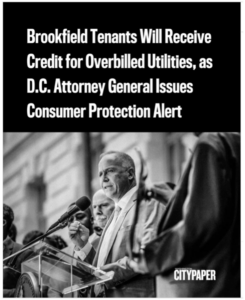
One tenant said that more than $100 in additional utility fees were added to his monthly bill. He said that he also paid a $250 holding fee for his apartment, which he never received a refund for. In 2025, this tenant filed a class action lawsuit against Brookfield, alleging that property managers charged tenants illegal application fees, common area fees, and a slew of other undisclosed fees that are “unlawful, unfair, and/or deceptive under the D.C. Consumer Protections Procedure Act.” The lawsuit is currently pending.[3]
When the DC-based newspaper Washington City Paper investigated and tried to learn more about Brookfield’s fees, the paper concluded that Brookfield’s explanation “provides little clarity to prospective tenants on how utility fees are proportioned.” A Brookfield fee schedule listed fees for stormwater, trash collection, gas, and common area electric fees as “allocated,” with no dollar amount or formula showing how the fees are calculated. After Brookfield accidentally included a tenant on an email thread with the company’s utility billing service, Brookfield admitted that it had been overcharging some residents for almost two years.
“This is direct evidence that private equity puts profit over people. People and families across the U.S. are significantly rent burdened and do not have disposable income to waste,” said another tenant. “It’s clear that Brookfield is unconcerned with the stability of its tenants’ housing.”
[1] “Brookfield says multifamily buying spree is paying off,” PERE News, September 15, 2024
[2] “Brookfield Becomes San Francisco’s Largest Multifamily Landlord,” Globe St., January 22, 2024
[3] Probst v. Brookfield Properties Multifamily, 1:25cv636