Carlyle ranks near bottom on climate scorecard amid oil and gas expansion
November 10, 2026
Carlyle ranks near the bottom among peers on the 2026 Climate Scorecard while recent oil and gas deals threaten net-zero goals
The Carlyle Group and its subsidiary, NGP, have a long history of fossil fuel-intensive energy investments and have been on an oil and gas acquisition spree since last year, with 14 oil and gas deals totaling at least $9 billion since January 2025. Many of the deals have been through the firm’s partnership with Diversified Energy, but while the firm’s North American fossil fuel acquisitions have been successful, several high-profile overseas deals have failed.
Overall, the firm continues to rank as one of the worst when compared to its peers on its fossil-fuel-heavy energy portfolio and its progress towards transitioning its portfolio away from fossil fuels. The 2026 Private Equity Climate Risks Scorecard found that Carlyle again earned a D and ranked as the third-worst firm out of the 20 private equity firms analyzed.
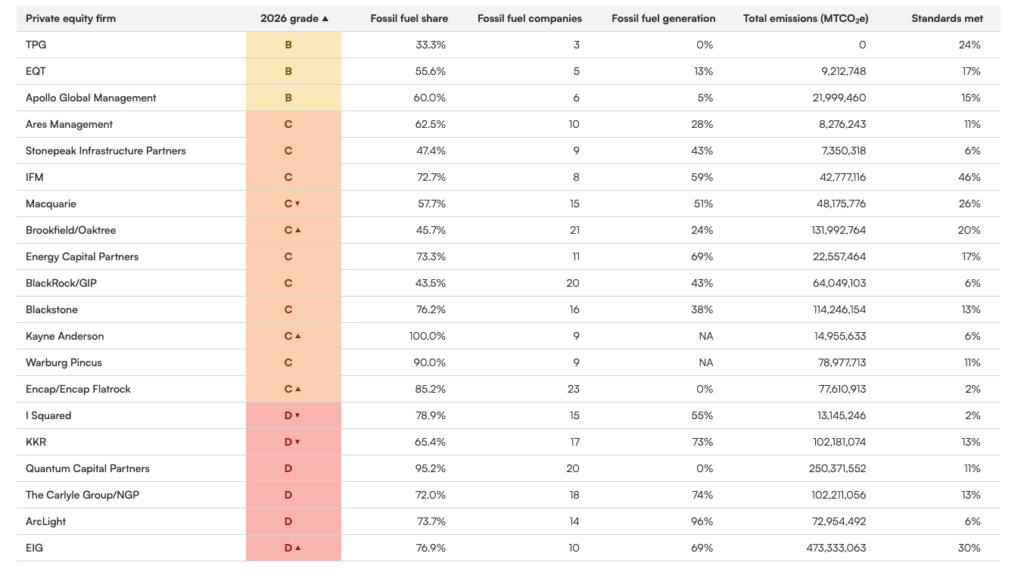
While the firm did show some improvements on several of the metrics compared to its score in the 2024 Private Equity Climate Risks Scorecard, it still ranked as the second-worst in generation, with 74% of its power-generating assets coming from fossil fuels, and ranked as the 5th highest in estimated emissions associated with its fossil fuel investments.
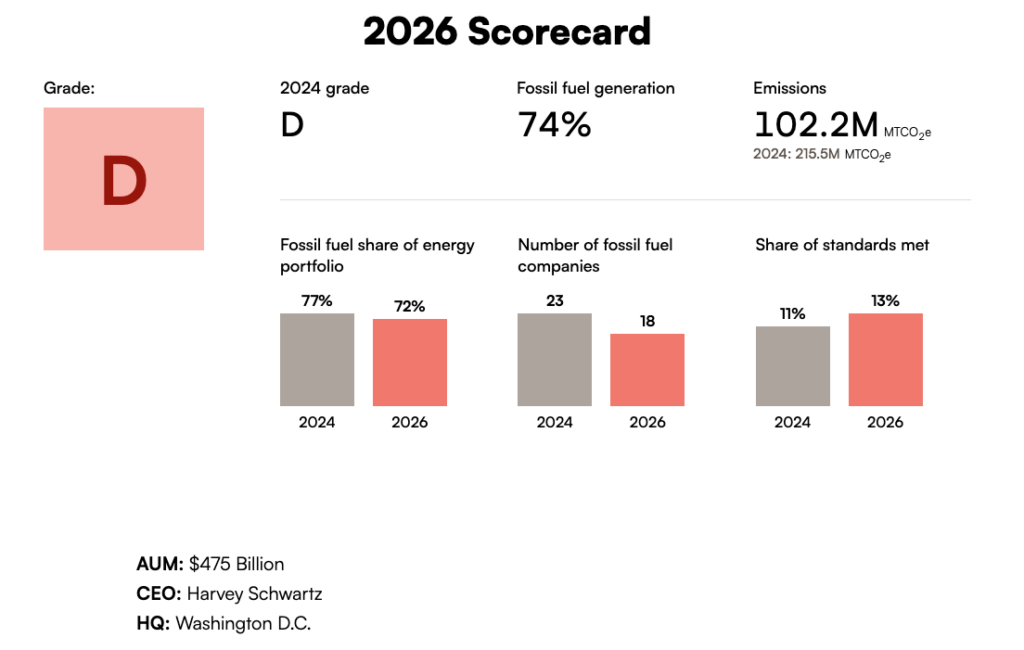
Since the 2024 scorecard analysis, Carlyle pared down its exposure to downstream power plants in its energy portfolio; the firm sold Cogentrix, the firm’s largest portfolio of gas-fired power plants, which included four coal-fired power plants, to private equity firm Quantum Capital. NGP also exited a few upstream oil and gas drilling companies. These factors contributed to Carlyle’s overall decrease in emissions in the 2026 Scorecard. However, that score only reflects the firm’s holdings as of January 2026. In the months since, the firm has invested in additional oil and gas infrastructure, the scope and scale of which would likely negate the noted improvements in the firm’s emissions score. If Carlyle’s score were calculated today, it would be worse than reported in the analysis.
Carlyle’s $9 billion recommitment to fossil fuels
Carlyle has been aggressive in its fossil fuel acquisition strategy over the past year and a half, with two of the firm’s major acquisitions taking place this past summer. In July 2026, Carlyle agreed to acquire upstream drilling company Parallax Energy, with operations in Alberta, Canada, and the firm finalized its acquisition of Altera Infrastructure’s Floating Production Storage and Offloading (FPSO) business. Altera Infrastructure’s FPSO fleet operates in major offshore oil and gas regions including Brazil, West Africa, and the North Sea, specializing in offshore deep-water oil drilling. This deal marks Carlyle’s first completed overseas fossil fuel asset acquisition after several high-profile failures.
Carlyle builds its empire of wells with Diversified
Since Carlyle partnered with Diversified and its empire of aging and decaying wells in June of 2025, it has made several large upstream oil and gas drilling and exploration acquisitions, totaling an estimated $5.5 billion, according to data available from PitchBook. In September 2026, Carlyle-backed Diversified took on its largest acquisition in the company’s 25-year history when it agreed to purchase upstream oil and gas company Birch Permian for $1.5 billion. When complete, the deal would add around 480 wells and 46,000 net mineral acres in the Permian Basin to Diversified’s portfolio. Carlyle-backed Diversified has also acquired Oklahoma upstream assets from Camino Natural Resources for $1.18 billion, Sheridan Production Partner’s East Texas assets for $245 million, and Canvas Energy’s upstream properties in Oklahoma, all since June 2025.
Before these recent acquisitions, Diversified was already one of the largest well owners in the country. A 2021 investigative report by Bloomberg found the company had built its massive portfolio of around 69,000 gas wells in the United States through a strategy that focused on buying up old and dying wells. Earthworks, a nonprofit organization that specializes in field investigations identifying methane leaks, found that Diversified sites in the Appalachian basin showed evidence that the company failed to conduct frequent inspections for harmful pollution at the vast majority of the wells inspected. Earthworks thermographers recorded methane emissions, or leaks, at several of Diversified’s wells that otherwise cannot be seen without optical gas imaging. Despite Diversified’s concerning track record, Carlyle chose to partner with the company and has bolstered its expansion of its empire of wells with financial and operational support.
Overseas oil and gas expansion faces more failures
While Carlyle continues to expand its North American oil and gas portfolio, the firm has faced multiple high-profile deal failures in its attempts to build out its overseas portfolio, with some assets in high-risk areas, even while Carlyle leadership raises concerns over geopolitical risks associated with overseas energy infrastructure.
In April 2026, Carlyle CEO Harvey Schwartz said at Semafor’s World Economy Summit that markets are mispricing geopolitical risk and that “complacency is causing investors to downplay the gravity of geopolitical risk in the global economy,” PitchBookreported. Schwartz made this statement while Carlyle was vying for Russian oil major Lukoil’s overseas fossil fuel assets, including oil fields in Azerbaijan, Iraq, the UAE, and the Congo. The tentative deal was for around $22 billion. In October 2026, Carlyle stated the deal had expired over the summer, and the firm was no longer actively pursuing the Lukoil assets, Bloombergreported.
The failed Lukoil deal marks Carlyle’s third major foreign asset acquisition failure since 2025, with the three deals adding up to around $40 billion dollars. Last year, the two major overseas energy acquisition failures were: Carlyle’s $945 million venture to acquire Energean assets in the Mediterranean and build an overseas upstream oil and gas platform, and the firm’s $18 billion bid alongside the Abu Dhabi National Oil Company (ADNOC) for Australian LNG producer Santos, which fell through after months of negotiations.
Continued oil and gas expansion increases risk for investors and threatens net zero goals
Despite Carlyle’s net zero by 2050 commitment announced in 2021, the firm appears to have embraced an energy strategy focused on acquiring more oil and gas drilling operations both in North America and abroad, while also leaning into the controversial, and increasingly unpopular, data center buildout through its partnership with the U.S. Army to build a massive data center on Fort Bliss in Texas and through NGP’s portfolio company, Cloverleaf Infrastructure, which is leading the data center development in the rural and historic Lowndes County, Alabama.
Some of Carlyle’s top investors also have net zero commitments, and generally many institutional investors are moving toward stronger standards for how and where their money is managed and how risk is managed. In addition to the warning about mispricing geopolitical risk from Carlyle’s CEO, BlackRock’s global head of sustainable and transition solutions stated that the markets are not adequately pricing climate risk. Private market investments, due to their opaque nature, increase the challenges in discerning investment risks even more. Investors should ask Carlyle how the firm’s fossil fuel expansion aligns with its own net-zero commitment and how it aligns with investors’ portfolio risk assessment and sustainability goals.
Carlyle Energy Deals Since January 2025:
| Companies | Deal Date | Investors | Deal Type | Deal Size ($USD Millions) |
| Mora Energy | 10-Apr-2025 | NGP Energy Capital Management, Old Ironsides Energy | PE Growth/Expansion | 250.00 |
| 406 Energy | 10-Oct-2025 | Carlyle Investment Management, NGP Energy Capital Management | PE Growth/Expansion | NA |
| Canvas Energy | 24-Nov-2025 | Diversified Energy | Merger/Acquisition | 533.09 |
| Kiwetinohk Energy | 18-Dec-2025 | ARC Financial, Cygnet Energy, NGP Energy Capital Management | Buyout/LBO | 924.69 |
| Preem | 31-Dec-2025 | Carlyle Investment Management, VaroPreem | Buyout/LBO | 2,152.50 |
| Valedor Energy | 01-Jan-2026 | NGP Energy Capital Management | PE Growth/Expansion | NA |
| Sheridan Production Partners | 30-Apr-2026 | Diversified Energy | Corporate Asset Purchase | 245.00 |
| Camino Natural Resources (Oil and Natural Gas Properties) | 02-Jul-2026 | Carlyle Investment Management, Diversified Energy | Buyout/LBO | 1,175.00 |
| Altera Infrastructure (FPSO business) | 21-Jul-2026 | Carlyle Investment Management, FTV Capital | Buyout/LBO | 5.71 |
| Mora Energy | 12-Aug-2026 | NGP Energy Capital Management | PE Growth/Expansion | NA |
| West Texas Midstream Gas Services | 12-Aug-2026 | Mora Energy, NGP Energy Capital Management, Old Ironsides Energy | Buyout/LBO | NA |
| Birch Permian | 02-Sep-2026 | Diversified Energy | Merger/Acquisition | 1,800.00 |
| ExxonMobil (New Zealand Fuel Business) | 03-Sep-2026 | Carlyle Investment Management, Kohlberg Kravis Roberts | Buyout/LBO | 590.85 |
| Parallax Energy | 14-Sep-2026 | Carlyle Investment Management | Buyout/LBO | 1,400.00 |