
PESP research cited in Senator Murphy’s report on private equity
August 27, 2025
Federal report details failures at Connecticut hospitals under private equity ownership
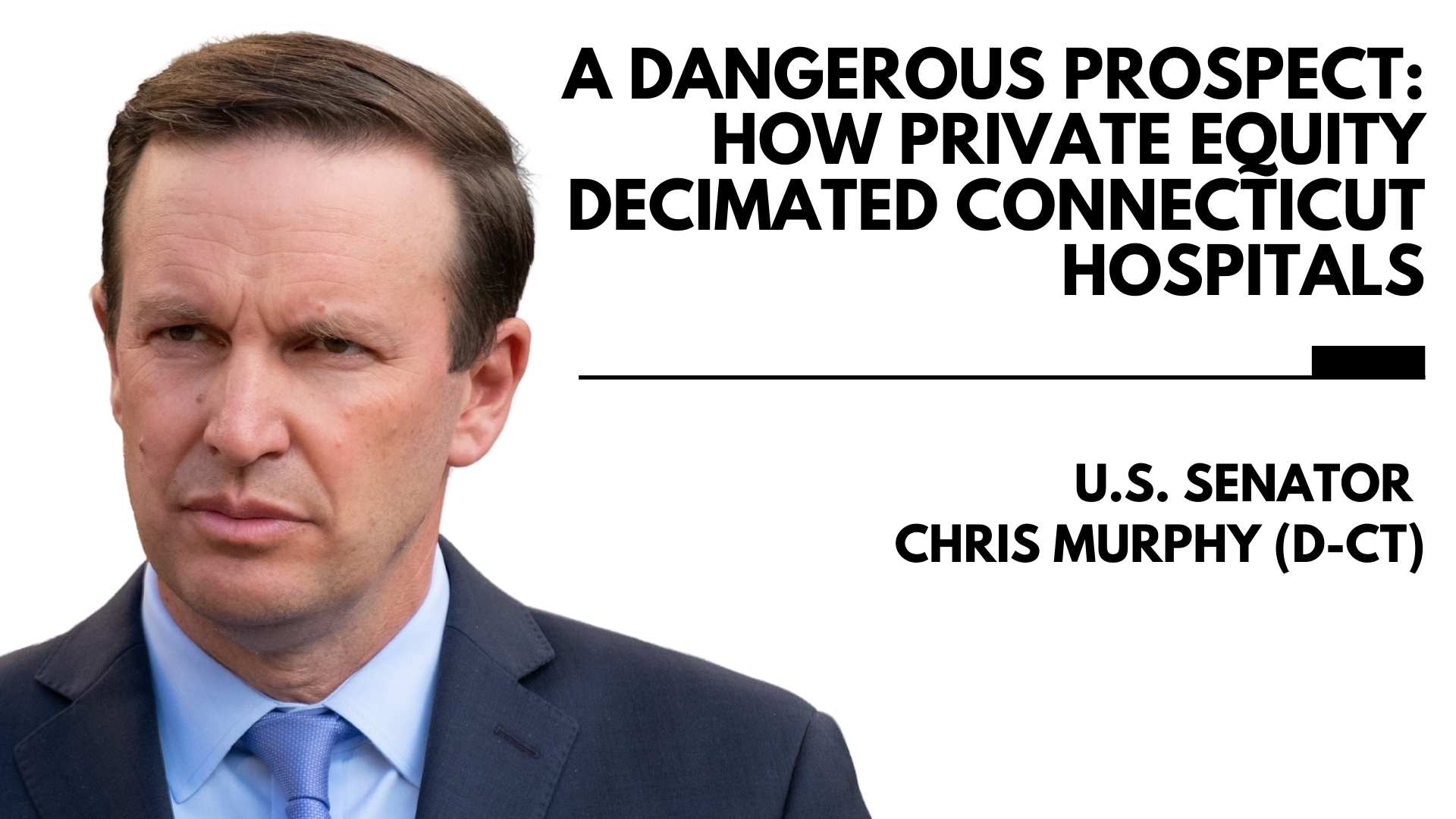
Last week, U.S. Senator Chris Murphy (D-CT) released a new report,A Dangerous Prospect: How Private Equity Decimated Connecticut Hospitals, documenting the devastating effects of private equity ownership on three hospitals in Connecticut. The report details how Prospect Medical Holdings, backed by the private equity firm Leonard Green & Partners, pursued short-term profits at the expense of patients, staff, and community health.
The findings are stark. According to the report, Prospect’s acquisition left hospitals in financial turmoil, with failing infrastructure, unsafe conditions, and mounting debt, all while executives enriched themselves. The consequences have been severe for patients and frontline healthcare workers across Connecticut, and the story echoes a national pattern of private equity’s influence in healthcare.
PESP’s Role in Shaping the Narrative
The Private Equity Stakeholder Project’s research is cited multiple times in Senator Murphy’s report. In particular, the report references PESP’s Private Equity Hospital Tracker, which documents 488 hospitals across the United States owned by private equity firms. This resource helps policymakers, journalists, and community advocates understand the scale of private equity’s footprint in healthcare and the risks it poses for communities.
The report underscores the importance of transparency and accountability in healthcare ownership. It also demonstrates the growing recognition, at the highest levels of government, that policymakers must start understanding the systemic challenges private equity poses to hospitals and the patients who depend on them.
A Call for Oversight and Reform
Senator Murphy’s report concludes with a call to action: policymakers must strengthen oversight of healthcare transactions and ensure that financial engineering does not come at the expense of patient care. The report echoes what PESP has long argued — that unchecked private equity business strategies are incompatible with sustaining hospitals as vital community institutions.
Senator Murphy’s report also focuses on corporate greed and corporate resistance to industry reform. It makes clear that while Connecticut lawmakers recognized the dangers of private equity in healthcare—even advancing bipartisan proposals to strengthen oversight—industry lobbying pressures ultimately blocked meaningful change.
Connecticut State Representative Liz Linehan compared private equity in healthcare to a “cancerous tumor” that has infected the system, while Public Health Committee Co-Chair Cristin McCarthy Vahey warned, “private equity makes big tobacco look small.” Despite strong committee support, proposed legislation stalled after a wave of last-minute lobbying by financial industry representatives.
Even widely supported, bipartisan reforms have collapsed under the weight of entrenched corporate influence. As the report warns, without the political will to stand up to Wall Street firms and executives, communities will remain vulnerable to the same cycle of hospital buyouts, asset-stripping, and bankruptcies.
PESP’s Policy Recommendations
The financialization of healthcare in the United States is a multi-faceted issue that cannot be pinned on private equity alone. However, private equity business strategies are an amplification of the typical profit-seeking strategies seen in healthcare, and are having outsized impacts on the healthcare system. Much of PESP’s proposed policy solutions to address private equity in healthcare would go above and beyond regulating private equity investments in healthcare to address broader financialization of healthcare issues that show up in nonprofit and for-profit business models alike.
PESP’s policy recommendations could go far in reigning in the most exploitative business practices of private equity firms, real estate investment trusts, and other for-profit investors in US healthcare. However, in the current for-profit healthcare system, private players—be they for-profit hospitals, insurers, hospital landlords, or medical staffing companies–will continue to dictate access to and quality of healthcare unless our society shifts to treat healthcare as a public good and a human right.
Learn More
- Read Senator Murphy’s full report here:A Dangerous Prospect: How Private Equity Decimated Connecticut Hospitals
- Explore PESP’sPrivate Equity Hospital Tracker, cited in the report, to learn more about the extent of private equity ownership in U.S. hospitals.