

Private equity’s AI strategy: Early signs for workers
August 4, 2026
In May, multiple private equity firms announced deals with Open AI, Anthropic, and Google to deploy these companies’ AI tools at private equity firms’ portfolio companies. These deals incentivize private equity-backed firms to adopt specific tools that the private equity firms have invested in, potentially accelerating job cuts at private equity-owned companies.
Concerns over potential job losses related to AI implementation are multiplied by their application to the private equity playbook, where private equity firms are already focused on drastically increasing profitability in a short period of time. Even before AI integration, private equity buyouts have led to cost cutting that negatively impacted employees, including layoffs, closures, and lost wages.
Two examples in recent years show the kind of concerning corporate behavior that has led many to worry about PE’s newfound interest in supercharging AI implementation at their portfolio companies.
KKR acquires Axel Springer and cuts jobs in shift to AI
In 2020, KKR acquired the majority of the shares of Axel Springer, the publisher of Germany’s BILD newspaper. Before the end of 2021, the company had bought ten additional companies, including POLITICO and POLITICO Europe. In 2023, Axel Springer announced an aggressive AI implementation, a focus on digital-only news, and lay offs for hundreds of employees, or more than 20% of employees in some flagship newsrooms. Axel Springer told staff that it would “unfortunately be parting ways with colleagues who have tasks that in the digital world are performed by A.I. and/or automated processes.”
“Artificial intelligence has the potential to make independent journalism better than it ever was – or simply replace it,” Axel Springer CEO Mathias Doepfner said in an internal letter to employees.
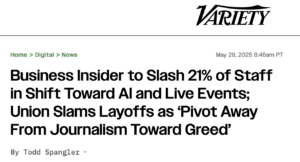
In 2025, Axel Springer laid off 21% of staff at Business Insider, which it acquired in 2015. As part of the announcement, Business Insider CEO framed the layoffs as part of their effort of “going all-in on AI.” The NewsGuild of New York, which represented employees at Business Insider, slammed the Axel Springer leadership for a “pivot away from journalism toward greed.”
In 2025, KKR reportedly split the company into two and took full control of Axel Springer’s lucrative advertising business. According to Axel Springer’s website, KKR still retains a 35.6% ownership stake.
By early 2026, the Axel Springer’s website landing page stated that: “Our guiding principle is: We shape and lead the future of AI empowered media in the free world.” The number of employees at Axel Springer has dropped from 17,000 in 2021, the year after the KKR buyout, to 10,000 employees today.
The Nielsen Company: Acquisition followed by massive layoffs
In 2022, private equity firms Elliot Investment Management and Brookfield Business Partners acquired Nielsen, a data analytics and audience measurement company. Before fully acquiring Nielsen, it was reported that the firm “wants Nielsen to move faster, invest more in technology, and rely less on people,” criticizing Nielsen for “mov[ing] way too slowly in embracing technology” and that it needed to focus on software-as-a-service, “rather than employing tons of people.”
After the acquisition, the new owners began slashing jobs, announcing layoffs of hundreds of employees in January 2023 as an effort to increase efficiency and profitability. Just a few months later, the company announced layoffs of about 9% of its workforce, noting that the company “will continue to prioritize areas that will drive innovation and the future of cross-media measurement.”
One news outlet reported at the time that the layoffs were “aimed at producing overall savings of $200 million annually to offset debt service on the roughly $10 billion in debt taken on to finance taking the company private last year.” In response, “Nielsen’s spokeswoman described those numbers as “way off,” but declined to disclose company financials.”
Nielsen has embraced AI in recent years, producing multiple reports on how AI tools can be used internally and by its customer base to improve analysis, where humans struggle with the overwhelming scale of data. After examining the effect that generative AI would have in transforming how brands and advertisers interact with measurement systems, Nielsen identified a number of methods by which AI tools would change the way media measurement occurs and how it would improve speed and quality of the analysis.
The firm highlights numerous ways it has begun using AI modeling in predictive media modeling, including a new tool announced in 2026 called Predictive Sales Lift, intended to analyze performance data across types and sectors.
The company’s last SEC filing from 2021, before being taken private by Elliot and Brookfield notes the company employs approximately 15,000 people worldwide. Just five years later, the company’s website touts approximately 13,000 employees, meaning their private equity owners eliminated around 2,000 jobs or over 13% of the global workforce.
As the company continues to implement AI into its own and its customers‘ workstreams, it is unclear how these new products will affect the company’s global workforce or whether there will be a more expanded AI implementation now that one of the firms’ private equity owners has signed on to a multi-billion dollar deal with OpenAI’s new deployment company.