
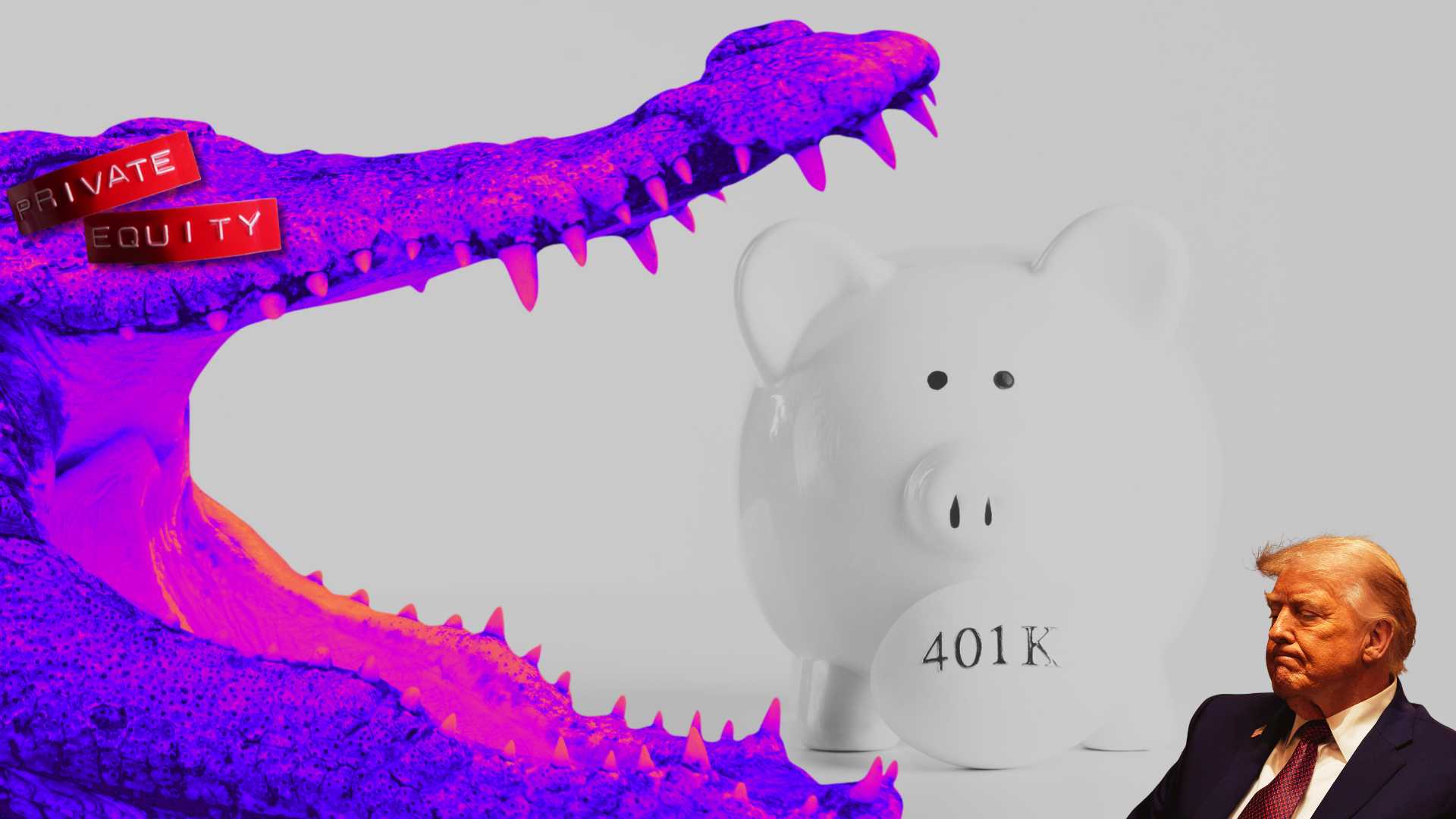
Trump admin bails out private equity, private credit with 401(k)s
March 25, 2026
Trump administration seeks to bail out private equity, credit with workers’ 401(k) savings, PESP warns
New rule expands access to private equity despite evidence of underperformance, high fees, and illiquidity risk
WASHINGTON, DC — The Trump White House yesterday concluded review of a new rule expanding access to private equity investments in 401(k) retirement plans. Following the White House’s completion of its review, the Private Equity Stakeholder Project (PESP) warned that the move could expose tens of millions of workers to higher fees, lower returns, and opaque risks that are poorly suited to retirement savings.
The rule follows President Trump’s push to open 401(k) plans to private equity and other alternative assets, a shift that could weaken long-standing fiduciary protections for retirement savers while benefiting Wall Street firms.
PESP is especially concerned about proposals to provide a regulatory safe harbor for private equity investments in 401(k) plans. President Trump’s executive order directed the Department of Labor to explore safe harbors that would limit the ability of consumers to sue if private equity managers or 401K managers or providers make recommendations that are contrary to their fiduciary duty to retirement savers, and multiple U.S. senators have pressed the department to formalize those. PESP warns that broad safe harbors could insulate private equity firms from scrutiny while shifting risk onto workers saving for retirement.
“Private equity firms should not get a free pass to loot workers’ 401K retirement savings; PESP opposes any safe harbor that would weaken fiduciary protections for retirement savers,” saidJim Baker, Executive Director of the Private Equity Stakeholder Project. “At a minimum, the Department of Labor should hold private equity to the same disclosure and transparency standards expected of publicly-traded stocks, mutual funds, and ETFs, including clear reporting on what funds are investing in, the fees and expenses retirement savers are paying, the amount of debt funds are using, and how these investments are actually performing compared with stocks.”
Recent headlines about Blue Owl Capital and other private credit managers restricting withdrawals from their private credit funds have rattled Wall Street. Since last month, several private credit managers including Blue Owl, BlackRock, Apollo, Ares, Cliffwater, and Morgan Stanley have moved to limit how quickly individual investors could get their money out after redemption requests surged, a reminder that even large private asset managers can halt redemptions when liquidity tightens.
The recent restrictions have made these private market funds’ liquidity risk visible. Investors discovered that when redemption requests surged, they couldn’t simply get their money out.
A recent analysis by PESP raises serious questions about whether private equity belongs in retirement plans at all. The research finds that private equity funds marketed to everyday investors have significantly underperformed public stock market indexes while charging far higher fees, undermining claims that these products offer superior returns.
Key findings include:
- In 2025, private equity evergreen funds delivered significantly lower returns than broad public stock market indexes, even before accounting for sales charges.
- Over the past three years, these funds returned roughly half the gains of public equities, including the S&P 500.
- Some private equity funds charge annual fees approaching 4 to 5 percent, compared with about 0.03 percent for a basic S&P 500 index fund.
- Public pension funds are pulling back from private equity, citing weaker performance, liquidity risks, and high costs, with nearly one-third reducing allocations in the past year.
- Private equity and private credit investments are illiquid by design and can restrict withdrawals during periods of stress.
“The bar for including private equity in 401(k)s should be extremely high,” Baker said. “Private equity funds have lagged public markets while charging much higher fees, and public pension funds are pulling back from the asset class. Instead, this rule risks shifting more financial risk onto workers who rely on their retirement savings for long-term security.”
Many Americans already rely on their 401(k)s when financial emergencies hit. Last year, a record 6 percent of workers in Vanguard-administered plans took hardship withdrawals, often to cover medical bills or avoid eviction.
Warnings about retail investors being exposed to private markets are not coming only from critics. In a recent Reuters interview about private equity and credit access to retirement savers, Joshua Harris, a co-founder of private equity and credit giant Apollo Global Management, put it bluntly: “my own view is that it’s not going to end well.”Other private market executives also acknowledge the liquidity issue. Carlyle CEO Harvey Schwartz recently remarked that some private capital funds might more accurately be described as “sometimes not liquid at all.”
There is also a disconnect between how private markets are marketed and what retirement savers actually want. Last fall, surveys from AARP found that support for adding private market and cryptocurrency investments to retirement plans drops sharply once people learn about illiquidity, high fees, and limited transparency. Reporting by The Wall Street Journalfound similar skepticism when workers understand what these investments really mean for their savings.
“Retirement accounts exist to provide security, not to bail out private market investments by shifting liquidity risk onto workers when markets turn,” Baker said.
Read PESP’s analysis on private equity performance here:
https://pestakeholder.org/reports/private-equity-underperforms/