
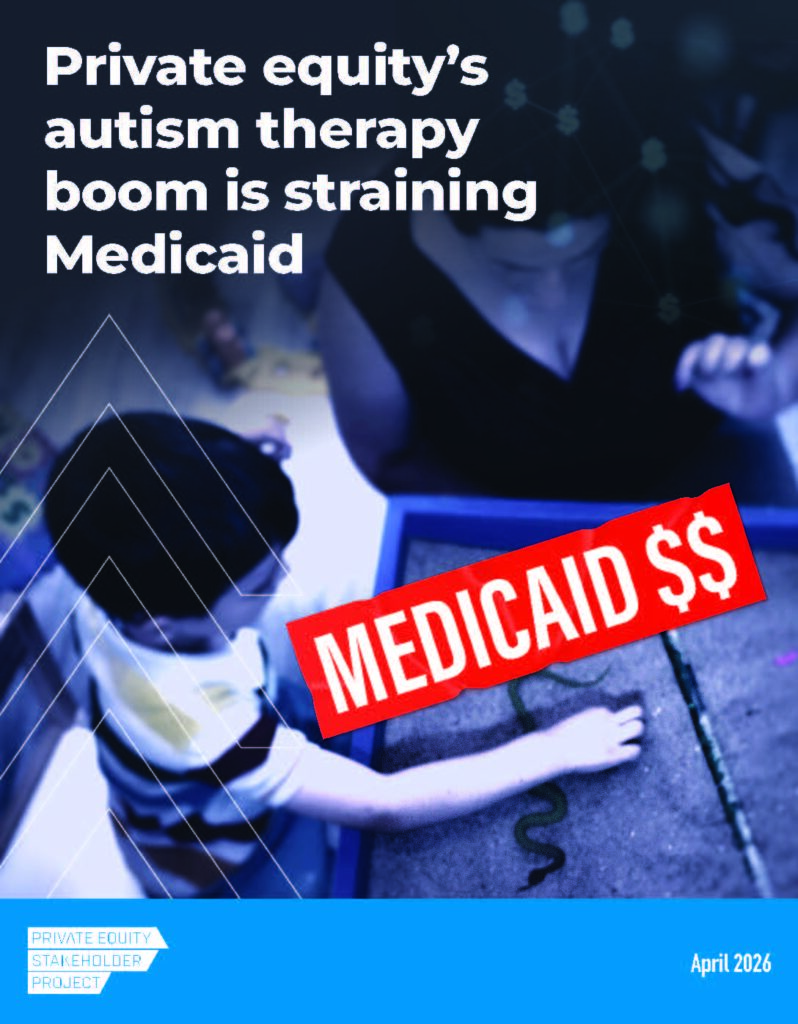
Private equity’s autism therapy boom is straining Medicaid
April 15, 2026
Private equity firms have rapidly expanded into autism therapy services, scaling a Medicaid-funded model that is driving up costs while audits across multiple states have uncovered widespread billing and compliance issues.
As demand for autism services grows, states are facing increasing financial pressure. At the same time, federal Medicaid funding is expected to decline significantly in the coming years, putting additional strain on already stretched budgets.
This report examines how private equity has moved into the autism therapy industry, acquiring more than 500 centers over the past decade, and how that growth is intersecting with rising costs, oversight challenges, and concerns about quality of care.
What the report finds
Across multiple state and federal audits, investigators are identifying similar patterns:
- Widespread improper payments
- $77.8 million in Colorado
- $56 million in Indiana
- Up to $94.3 million in Wisconsin
- $16.7 million in Massachusetts
- Consistent billing and documentation issues, including unsupported claims and duplicate records
- Oversight and supervision failures that raise concerns about how care is being delivered
These findings are not isolated. Across states, they point to a broader pattern in how autism therapy services are being billed and managed.
A scalable model tied to rising costs
Applied behavior analysis (ABA), the most widely used autism therapy, often involves intensive schedules of 30 or more hours per week. This creates a model where revenue can increase by expanding the number of clients or the number of billable hours per client.
Private equity-backed providers have rapidly expanded in this environment, where growth is closely tied to billable services. Prior research and reporting have linked this model to concerns about staffing levels, supervision, and pressure to increase therapy hours, raising questions about both cost and quality.
Growing demand, shrinking resources
As autism diagnoses rise, Medicaid spending on ABA therapy has increased quickly in many states. In some cases, the number of children receiving services has more than doubled in just a few years.
At the same time, more than $900 billion in federal Medicaid cuts are expected over the next decade, increasing pressure on states to manage costs while maintaining access to care.
Without stronger oversight, transparency, and regulation, the current system risks exposing state budgets, families, and workers to financial and care-related harm.
Policy recommendations
The report outlines steps policymakers can take to address these risks:
- Continued and expanded audits of ABA providers
- Greater transparency into ownership, billing, and outcomes
- Stronger state oversight at the facility level
- Requirements that a larger share of payments go toward direct care staffing
Download the report