

Landmark greenwashing case in France and new lawsuit against Canadian pension fund could be a sign of a new era of accountability
December 19, 2025
Climate disasters are accelerating at an exponential rate, with the first half of 2025 rated as the costliest ever on record at $101 billion, The Guardian reported. More and more people are becoming all too familiar with what a rapidly changing climate can do to their communities, with record-breaking, deadly fires and floods devastating the country and pulling more people into the ever-growing population on the front lines of climate chaos.
While the political climate in the United States is making tackling the climate crisis more challenging, new legal actions may be laying the foundation for real climate action outside of the United States. In France, a landmark greenwashing case against TotalEnergies could be a sign that the tides are turning and that a 2024 greenwashing complaint against BlackRock could prove to be successful. In North America, a new lawsuit against one of Canada’s largest pension funds, Canada Pension Plan Investment Board (CPPIB), which alleges the fund is failing to protect pensions from climate risk due to its portfolio of fossil fuels, could be a sign of a new era of climate accountability.
Many private equity firms with large portfolios of fossil fuels also maintain sustainability commitments through net-zero targets, transition plans, and participation in decarbonization initiatives such as the Private Markets Decarbonisation Roadmap. Many large American public pension funds have investment practices similar to CPP Investments. Could these legal actions have implications for private market investment in fossil fuels? Could U.S. pension funds face the same scrutiny as CPP Investments?
French Oil Major Faces Greenwashing Charge by Court – Could PE Firms Face the Same Fate?
Advocates in France successfully used the country’s new greenwashing laws against a fossil fuel company for the first time, leading the Paris civil court to rule that TotalEnergies engaged in “misleading commercial practices” regarding its environmental commitments. The case was brought by environmental advocacy groups, Friends of the Earth France and Greenpeace France. The October 2025 ruling ordered TotalEnergies to remove misleading statements that said the company placed sustainable development at the heart of its strategy from its website or face a daily fine, post the ruling on the company website, and pay each of the environmental organizations involved in the case €8,000, along with €15,000 for each organization’s legal costs.
Jonathan White, ClientEarth lawyer in the case stated: “This landmark judgment sends a clear warning shot to other oil and gas majors in Europe and beyond,” he said. “Claiming to be part of the transition while backing new fossil fuel projects comes at a tried-and-tested legal price.” While TotalEnergies is a publicly traded company, it does partner with private equity firms in fossil fuel investments. Many private equity firms invest in, create, and acquire fossil fuel assets, amassing their own portfolios with operations around the world, not unlike publicly traded oil and gas majors.
Despite climate chaos reaching new heights, private equity firms continue to expand their fossil fuel portfolios. Along with traditional oil and gas production, private equity firms are also fuelling the LNG buildout, building new fossil fuel power plants, keeping old ones online, and even buying up critical energy utilities in order to power the speculative AI boom. At the same time, private equity firms like Carlyle and BlackRock’s Global Infrastructure Partners (GIP) are also attempting to position themselves as committed to sustainability and the energy transition while continuing to expand their fossil fuel portfolios. Could this new era of greenwashing accountability reach into the private equity sector? If so, the time is now to right the course towards a real energy transition to reduce the risks for private equity investors and the planet.
Carlyle Touts Net Zero Progress While Expanding Fossil Fuel Portfolio
Though Carlyle is a U.S.-based private equity firm with the majority of its fossil fuel portfolio inside the U.S., the firm may face continued challenges in its attempt to expand its control of energy assets outside of the country, as Carlyle’s own sustainability and proclamations of net zero progress could come under scrutiny.
In 2022, Carlyle announced its commitment to reach net zero greenhouse gas emissions (GHG) by 2050 or sooner. While it is a step in the right direction, the firm’s net zero commitment lacked specifics and failed to commit to transparency around Carlyle’s fossil fuel holdings or its related emissions. Carlyle has also continued to acquire fossil fuel assets since its announced net zero commitment.
Carlyle reports broad emissions data related to its corporate operations (Scope 1 and 2), but only reports a small portion of the emissions related to its investment portfolio (Scope 3), which would account for close to 99 percent of its total emissions footprint. This omission in Carlyle’s reporting grossly undercounts the firm’s overall emissions footprint, for example, in 2024, Carlyle reported its 2024 emissions for Scope 1, 2, and a minimal aspect of Scope 3 were 153 thousand tons CO2e, while the PECR 2024 Scorecard found that just a portion of Carlyle’s fossil fuel portfolio (Scope 3) was responsible for 215.5 million tons CO2e. Since private equity firms are investment firms, it is essential to include Scope 3, specifically emissions from investments, in order to capture the full emissions footprint of the firm.
Carlyle also left its oil and gas subsidiary, NGP, completely out of the 2025 report. Carlyle has done this several times in the past, claiming that it does not have operating control over NGP or its investments, despite earning around half of Carlyle’s profits from NGP and its investments in 2022. Carlyle has owned a majority stake in NGP since 2012, a firm with at least 17 fossil fuel-based energy companies in its portfolio. Further, a 2023 analysis by Private Equity Stakeholder showed that between 2014-2021, the estimated emissions from NGP’s fossil fuel portfolio grew significantly under Carlyle’s ownership, all while claiming, “At NGP, we invest in high-quality, economically competitive and sustainable businesses helping to transition global energy systems to a cleaner and low-carbon future.”
Significant omissions combined with a lack of detail in Carlyle’s sustainability reports make the firm’s claims of net zero progress hollow. Continuing to tout commitments to sustainability while bolstering its dirty fossil fuel portfolio with multiple attempts to expand it even further overseas could be seen as greenwashing.
BlackRock Faces Greenwashing Complaint While Doubling Down on Fossil Fuels
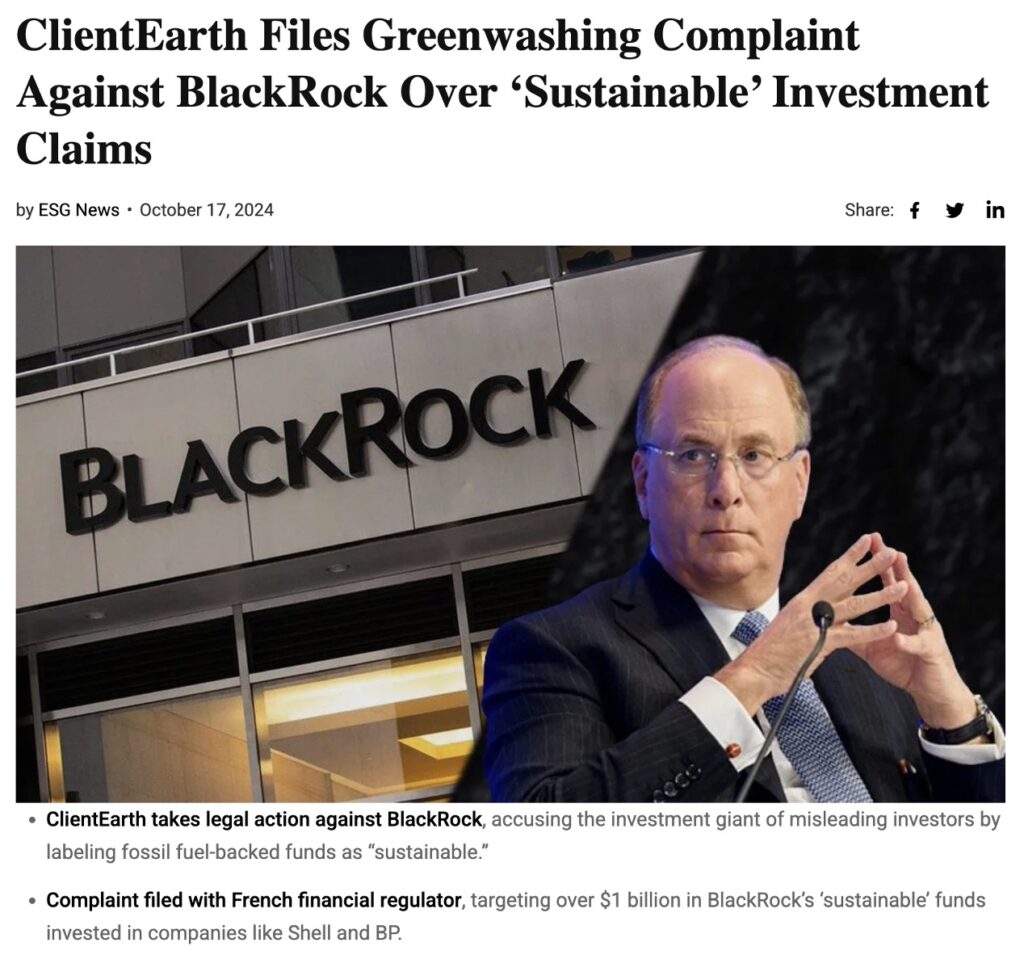
BlackRock is the largest asset manager in the world, managing a global portfolio of $10 trillion. In October of 2024, BlackRock acquired private equity firm Global Infrastructure Partners (GIP), adding approximately $170 billion in private infrastructure investments to its portfolio including Rio Grande LNG, a proposed LNG terminal that is estimated to emit the equivalent emissions of 44 coal power plants every year, which is invested in through GIP Fund V, a fund billed as an energy transition fund. Using the same fund, BlackRock’s GIP also recently acquired ALLETE Inc., the parent company of Minnesota Power, a retail energy utility directly serving about 150,000 customers in Northern Minnesota. ALLETE is also the parent company of a coal mine and multiple natural gas-fired power plants.
BlackRock has also proposed a $38 billion take-private acquisition of AES, one of the largest publicly traded utilities in the country, with 23 fossil-fuel fired power plants in its portfolio. BlackRock’s acquisition spree is ongoing despite having its own ESG policies and GIP stating on its website, “We aspire to be one of the world’s leading owners, developers, and operators of renewable energy assets.” The firm has one pending greenwashing complaint against it in France.
Source: ESG Dive
BlackRock has consistently been making headlines about the firm’s rollback of ESG commitments since Donald Trump took office in 2024, including leaving both the Net Zero Asset Managers (NZAM) and Climate Action 100+ initiatives. These decisions have created concerns from BlackRock institutional investors looking to derisk their portfolios from fossil fuels and move their energy and infrastructure portfolios towards a decarbonized energy economy. Earlier this year, PFZW, one of the largest public pension funds in the Netherlands, pulled €14.5 billion from BlackRock as a result of the decision to remove itself from climate initiatives, telling Bloomberg, “PFZW has been developing a new investment strategy where financial performance, risk and sustainability are weighed equally within the framework of a total portfolio approach”. In the U.S., New York City Comptroller Brad Lander recommended New York City pensions’ trustees move public markets funds away from BlackRock for failing to meet the Systems’ climate expectations, saying, “our Net Zero plan is a core part of our fiduciary duty to protect these assets. I am pleased to report that 46 of our 49 public markets managers are aligned with our expectations for decarbonization; unfortunately, three are not. Today, I am calling on my fellow trustees to move our money away from the three asset managers – BlackRock, Fidelity, and PanAgora – who fail to address climate risk with the seriousness we expect.”
Currently, BlackRock and its private equity infrastructure arm, GIP, both have ESG policies that have vague qualitative goals around managing portfolio companies in alignment with best practices. For example, some of GIP’s ESG Objectives include “active management of ESG integration across portfolio companies post-investment and expansion of ESG engagements with portfolio companies and management” and “promotion of an investment approach benefiting all stakeholders, society, and the environment” without specific goal posts outlined. BlackRock’s 2024 Climate Report touts alignment with the Taskforce on Climate-related Financial Disclosure (TCFD) but does not include quantitative metrics around emissions reductions or transition-related efforts for the company’s private markets holdings. GIP reports some figures related to its ESG initiatives, but only for 2023. According to the company’s disclosures in 2023, 64% of their portfolio companies have GHG emissions targets (related to Scope 1 and 2 emissions), and 80% of those companies are on track to achieve the targets. There is little detail about what those targets are and on what timeline the companies are hoping to achieve said targets.
Canadian Pension Fund Comes Under Fire
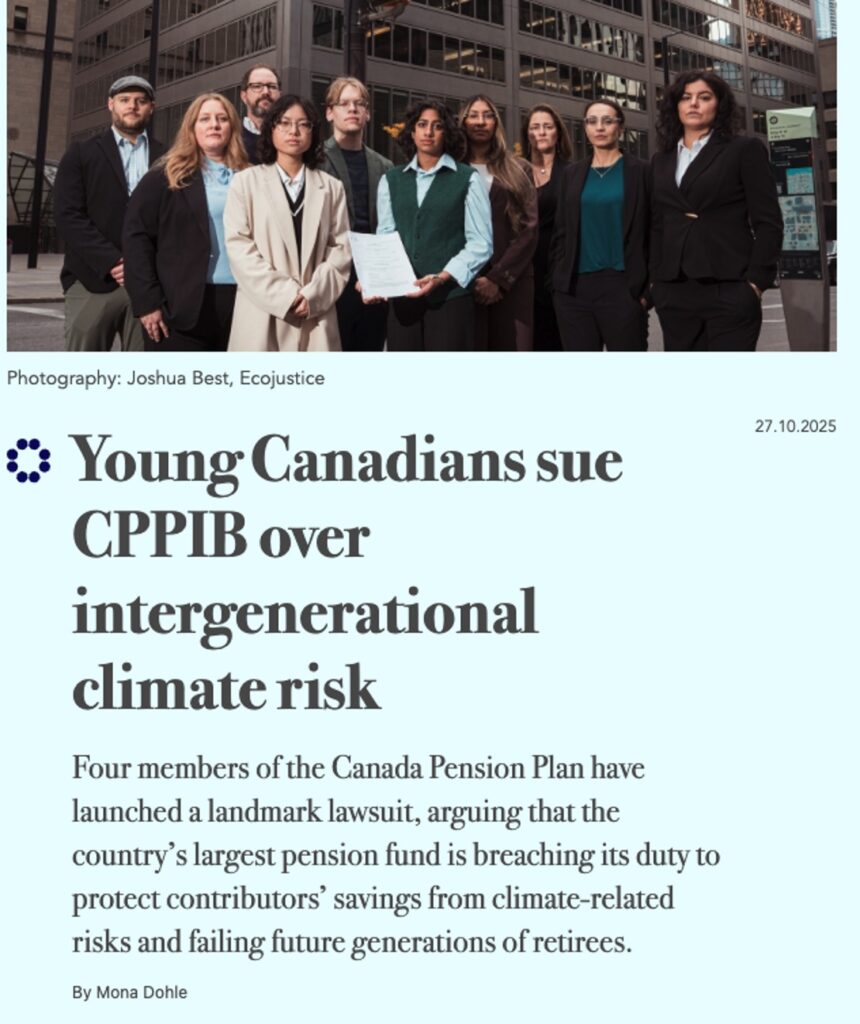
A public pension fund is the target of a new lawsuit filed against the Canada Pension Plan Investment Board (CPPIB) by a group of four young Canadian workers represented by lawyers from Ecojustice and Goldblatt Partners LLP. The lawsuit alleges the world’s sixth-largest pension fund is putting the workers’ future pension benefits in jeopardy and “is breaching its duty to invest in their best interests by failing to protect their pensions from climate risk.” This lawsuit marks the first time a Canadian pension fund has been sued for allegedmismanagement of climate risks, coming just a few months after CPPIB abandoned its net-zero commitment, which was made three years prior. The complaint alleges that CPPIB has ineffective engagement practices regarding climate-related financial risks and relationships to private equity firms.
Source: Net Zero Investor
This lawsuit against CPPIB is pathbreaking in the efforts to move pension fund investments away from fossil fuels. Karine Peloffy, lawyer and sustainability finance lead at Ecojustice, stated at a press conference that other major Canadian funds could face similar challenges, Net Zero Investorreported.
CPPIB’s Strong Ties to Fossil Fuels
CPPIB is one of the largest pension funds in Canada, with a total of CA$714.4 billion in net assets, with 21% of its assets in private equity. In the 2024 Canadian Pension Climate Report Card published by advocacy and research organization Shift: Action For Pension Wealth and Planet Health, CPPIB ranked second to last of the Canadian pensions, earning a C-. The report analyzed the climate policies of Canadian pension funds, using publicly disclosed information, and found the CPPIB’s score decreased in two sub-categories from the previous report card, including on its Paris-aligned targets, climate urgency, and earned an F in interim targets and fossil fuel exclusions.
Shift’s analysis does not include investments CPPIB is tied to through its private equity investments. Based on data available from PitchBook, CPPIB has committed hundreds of millions of dollars to Carlyle and Blackstone, both of which maintain expansive portfolios of fossil fuel assets themselves. CPPIB is also a partner in BlackRock’s purchase of ALLETE and now owns 40% of the Northern Minnesota utility
Could More Pension Funds See Similar Legal Challenges as CPPIB?
While there has been progress generally with pension funds moving away from direct fossil fuel investments, most of the large pension funds commit hundreds of millions of dollars to private equity funds with investments in fossil fuels. A few pension funds, especially in Europe, have made it clear they are moving away from fossil fuel investments and have made great strides in including private market investments in those efforts. The Dutch fund Stichting Pensioenfonds ABP set a portfolio-wide absolute emissions reduction of 50% by 2030 and a target to exit oil, gas, and coal in private markets as well. PFZW, another Dutch fund, has been divesting its public equity portfolio from oil and gas companies, and as mentioned above, recently announced that the fund has withdrawn approximately €16.4 billion from BlackRock due to ESG concerns.
In North America, most large institutional investors have taken some steps to incorporate sustainability into investment policies as part of a fiduciary duty to mitigate risks as investors seek returns. New York City pensions are leading the way in the U.S., with net zero by 2040 commitments along with private market exclusions on investments in upstream oil and gas companies. In addition, New York City Comptroller Brad Lander also proposed a policy to cease investments in midstream and downstream fossil fuel companies, also including private markets. As mentioned above, New York City Comptroller Brad Lander recommended New York City pensions’ trustees move public market funds away from BlackRock due to the firm’s failure to meet the pension’s climate expectations. California Public Employees Retirement System (CalPERS) and California State Teachers Retirement System (CalSTRS) have made commitments to reach net zero by 2050, though neither has included clear private market investment exclusions for fossil fuel companies. Both California funds have significant investments in private equity firms with large fossil fuel portfolios.
Despite progress by pension funds to steer portfolios toward the opportunities in a clean energy future and mitigate climate risks and related financial and legal liabilities, many have remained steadfast in their commitments to some of the largest private equity firms with expansive fossil fuel portfolios. These investment behaviors could make both pension funds and private equity vulnerable to scrutiny and accusations of greenwashing.