Private equity investments in LNG terminals face mounting risks
July 28, 2026
Private equity firms fund risky LNG projects despite severe market volatility and community opposition
In June 2026, ownership data for 46 private equity-backed liquefied natural gas (LNG) terminals were updated in the Private Equity Climate Risks Global Fossil Fuel Asset Tracker. Private equity firms have investments in LNG terminals around the world and continue to be a driving financier of the LNG buildout in the United States. LNG is natural gas, composed mostly of methane, that is converted into a liquid state to facilitate more efficient storage and transit, and is responsible for significant greenhouse gas emissions and significant impacts on communities and the environment. While industry groups and companies market LNG as a transition fuel, recent research shows that its greenhouse gas footprint is 33 percent higher than coal’s.
Investments in LNG terminals face increasing risks, including geopolitical risks due to their proximity to conflict zones, cancellations and significant delays to projects in development, and an unstable long-term gas demand. In addition, the private equity-propelled rapid LNG buildout in the United States has impacted gas affordability for American communities and businesses.
Please explore the map of private equity-backed LNG terminals here.
Private equity firms invest in these LNG terminals directly or through the firm’s portfolio company. Thirty-five of the 46 assets are currently operational, many with proposed expansions. Eleven PE-backed terminals are in various stages of development but not yet operational. The LNG terminals included in the asset tracker are LNG export terminals, LNG import terminals, and floating storage and regasification units (FSRU), which are essentially floating LNG import terminals.
Private equity firms have investments in fossil fuel assets across the LNG value chain, including upstream shale gas drilling, gas pipelines, and LNG tankers, also known as the LNG “pipelines of the sea.” Some of the LNG tankers backed by private equity firms also face increasing geopolitical risks due to their route proximity to high-risk geopolitical conflict zones.
Geopolitical risks increase LNG market volatility
The erratic and escalating conflict between the United States and Iran has had an outsized impact on the global oil and LNG markets. The Strait of Hormuz, located at the mouth of the Persian Gulf, is one of the most important global transit zones for the oil and LNG industries, and is on the frontlines of the geopolitical conflict. Around 20 percent of the global LNG supply moves through the Strait, and waterways within the Strait of Hormuz have been completely closed or partially blocked by either the U.S. and/or Iran since the conflict began in late February 2026. As of June 15, 2026, Iran and the U.S. have agreed to a peace deal with plans to reopen the Strait, Reuters reported.
The closure of the Strait of Hormuz stops roughly a quarter of the LNG trade supply from entering the market, which has caused a significant shock to high-importing countries in Asia and Europe. In a longer-term outlook, there is increasing concern that continued supply unreliability and price volatility are hindering longer-term demand. The International Energy Agency’s (IEA) April Gas Market report showed that LNG demand has decreased in importing markets due to the volatility, with Europe leaning on stronger renewable energy generation and Asian countries implementing demand-side measures like fuel-switching to limit gas use amid the supply crisis.
Beyond oil and LNG tanker routes being stopped or disrupted, both Iranian and U.S. forces have been attacking commercial tankers, and Iran has targeted and hit several oil and gas terminals in the Strait.

While private equity firms make financial bets on LNG terminals and LNG tankers, investors may be the ones to pay the price. An investigation by The Bureau of Investigative Journalism, with research support from the Private Equity Stakeholder Project, highlighted how the U.S.’s war on Iran could impact U.K. pensioners. Several U.K. pensions have capital tied up in private equity funds that are investing in these high-risk LNG terminals and tankers operating in and around the frontlines of the conflict zones. Two private equity-linked LNG terminals are operating in or near the Strait of Hormuz: Bahrain Hidd FLNG Terminal, owned and operated by Seapeak, which is a portfolio company of private equity firm Stonepeak, and Oman Qalhat LNG Terminal, which was owned by Naturgy Energy Group, a major Spanish energy utility backed by IFM Investors. Naturgy recently sold its stake in the project and is in negotiations for a new gas purchase contract with Oman.
Community and Indigenous-led Opposition to PE-backed LNG Projects
Along with geopolitical and market volatility, LNG terminals’ unpopularity among communities stems from their high-intensity emissions and the overall destruction and industrialisation of rural and biodiverse areas. Communities have organized around the world to halt proposed private equity-backed LNG projects, notably in the Gulf Coast of the U.S., the Gulf of California in Mexico, and in Western Canada.
Ksi Lisimis LNG and Canadian LNG – Western Canada
KSI Lisimis LNG
The Gitanyow Hereditary Chiefs, a traditional indigenous government mandated to protect Western Canadian lands over which the Gitanyow Nation claims ownership, submitted a letter alongside 125 civil society institutions (including PESP) to major banks and pension funds responsible for financial support of the proposed Ksi Lisims LNG project in British Columbia, BC. Blackstone Energy Transition Partners, a transition fund of private equity firm Blackstone, anchored a group of investors that recently financed a $150 million investment in Western LNG, and is co-owned alongside Rockies LNG and the Nisga’a Nation. Western LNG is the developer of the project and the accompanying Prince Rupert Gas Transmission Project. The proposed LNG terminal is currently undergoing environmental assessments, seeking regulatory approvals, and aiming to reach a final investment decision later this year. While a June 2025 analysis by the Institute for Energy Economics and Financial Analysis (IEEFA) found the project faces infrastructure, regulatory, and financial risks, the project has been designated as of national significance by the Carney administration and submitted for special fast-tracking and possible taxpayer support.
The press release for the letter cites Simogyet Watakhayetsxw/Deborah Good:
“Investors considering financing Ksi Lisims LNG need to know that this project is an extremely risky bet for many reasons and continues to face mounting opposition. Gitanyow’s message is clear: we’ll continue to fight for our way of life and stand up against projects like this that threaten our Lax’yip.”
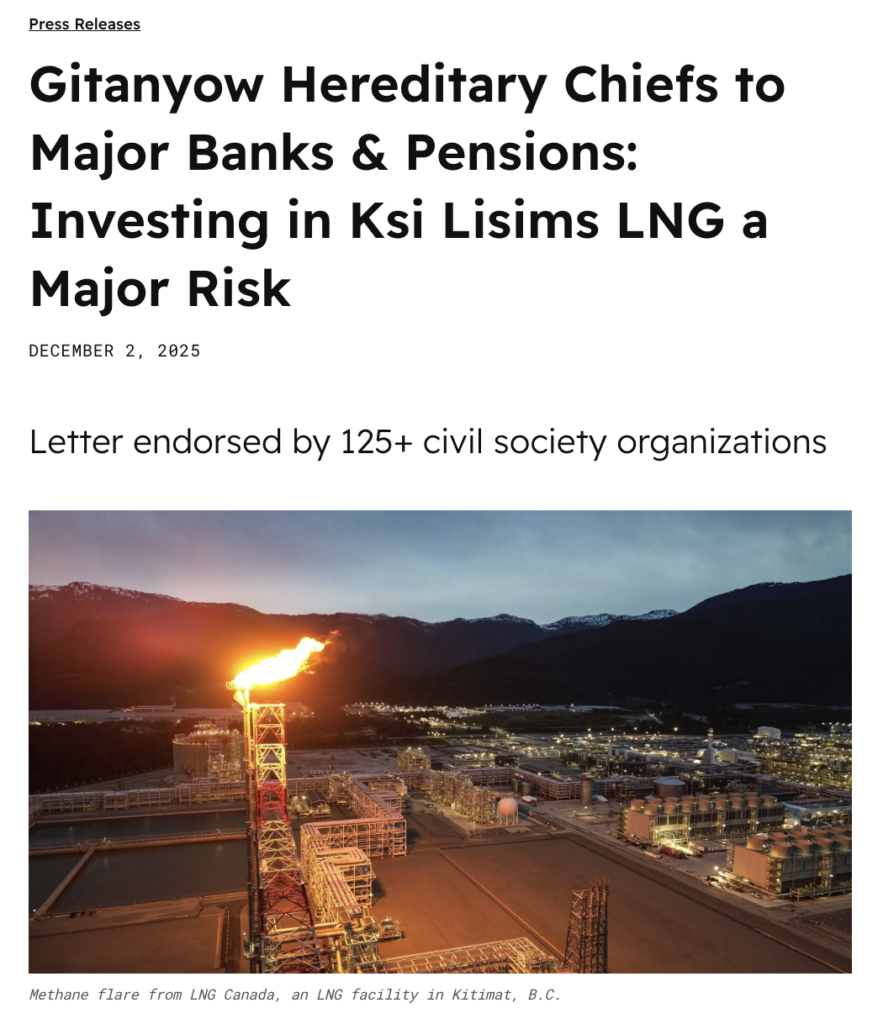
Source: STAND.earth
LNG CANADA
Wet’suwet’en Hereditary Chiefs and the Union of British Columbia Indian Chiefs (UBCIC) recently submitted a formal notice to ten of the largest pension funds in Canada, urging them not to invest in LNG Canada. LNG Canada is an operating export terminal with a proposed expansion in Kitimat, British Columbia. Private equity firm EIG acquired a 20 percent stake in the project through its portfolio company MidOcean Energy in September 2025. Private equity firms Apollo, Blackstone, and KKR are vying for a significant stake in LNG Canada for up to 15 billion dollars. An ongoing operational defect at Canada’s largest LNG facility was overlooked by regulators for months, as health-harming flaring exceeded permits by 40 times on average for warm/wet and cold/dry flares, according to an April 2026 analysis by the Canadian Association of Physicians for the Environment (CAPE).
The press release published by STAND.earth states:
“Any institution that invests in LNG Canada is complicit in the ongoing violation of Wet’suwet’en rights and title,” said Chief Na’Moks, Hereditary Chief of the Tsayu (Beaver Clan). “LNG Canada cannot exist without the Coastal GasLink pipeline that feeds it, and any expansion of this infrastructure will be met with fierce opposition. ”
Canadian pensioners have also recently spoken out about how investing in LNG Canada and its proposed expansion is a breach of the fund’s fiduciary duty to its pensioners and future generations.
Rio Grande LNG – Cameron County, Texas
BlackRock’s Global Infrastructure Partners (GIP) has a substantial $3.5 billion investment in Rio Grande LNG, making the firm the largest investor with aminimum 46% ownership stake in the project. TheRio Grande LNG terminal would be built on land the Carrizo Comecrudo Tribe of Texas considers sacred. The facilities would significantly degrade local fishing, shrimping and natural tourism industries putting communities’ livelihoods at risk.
The Carrizo Comecrudo Tribe of Texas has been voicing their concerns about this project directly with GIP and investors at the Oregon Investment Council and the Washington State Investment Board. Despite this, GIP announced a significant additional investment in Rio Grande LNG; another investor, TotalEnergies, reportedly will not invest further in the project. In February 2025, TotalEnergies CEO Patrick Pouyanne hadexpressed interest in investing in Rio Grande LNG Trains 5, 6, and 7. However, by early August, Reuters reported, based on two sources “familiar with the matter,” thatTotalEnergieshad decided not to invest in a fifth LNG facility or purchase its LNG, stating that the company was prioritizing lower-cost LNG development elsewhere. TotalEnergies declined to comment for the article.
Vista Pacifico and Saguaro LNG – Gulf of California, Mexico
In February 2026, KKR-backed Sempra Infrastructure (SI) canceled the Vista Pacifico LNG project, a proposed natural gas liquefaction terminal that would have been built near the port of Topolobampo, Mexico, in Baja California, a UNESCO World Heritage Site known as the “Aquarium of the World.” The project has been in development for four years and was one of the LNG projects formally opposed by more than twenty environmental organizations alongside local fishing communities, tourism businesses, and academic institutions due to the social and ecological threats to the area. Ultimately, Sempra failed to obtain a key permit from Mexico’s National Energy Commission (CNE) required to construct Vista Pacifico LNG, which effectively killed the project.
Another project in the same Gulf that faced organized community-led opposition was the proposed Saguaro Energia LNG terminal. Private equity firm Quantum Capital was the principal financier of the project from 2021 until Quantum transferred ownership to Kronos Polo L.P. in May Feb 2025. As of mid-2025, Saguaro Energia LNG was effectively stalled due to significant delays caused by legal battles, regulatory hurdles, and delayed FID.
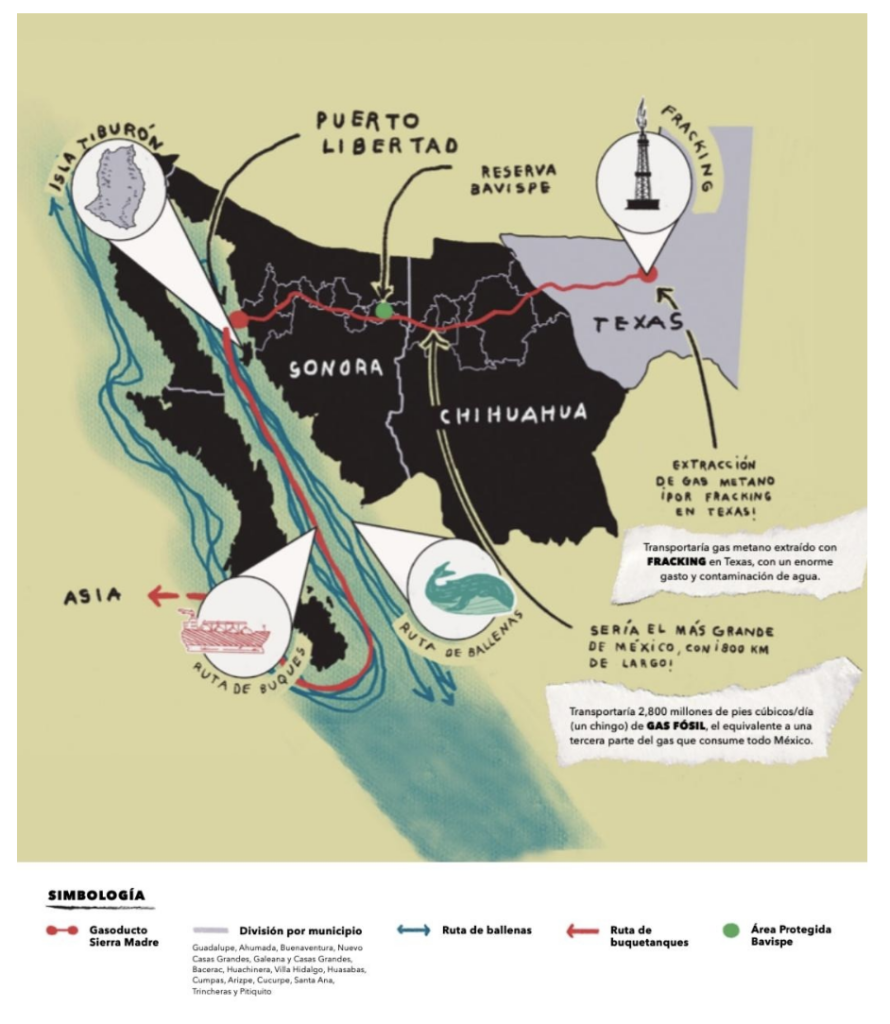
Photo credit: Conexiones Climáticas
Investors Should Heed the Call of Communities and Energy Experts
The future of the LNG industry is fraught with uncertainty. The development of LNG facilities has been found to be incompatiblewith pathways to limit global temperature increase to 1.5 degrees Celsius, and thus poses a financial risk to institutional investors. Recentstudiesexpect global equity returns to decline by 50% by 2060 if financial funds do not align with Paris Agreement goals. Future global demand for LNG is also highly uncertain. The IEA forecasts that demand for gas, oil and coal will all peak before 2030, and has noted that demand for gas growth has slowed considerably, leading to concerns about a “glut of LNG.”
Beyond risks for investors, the US LNG export industry has been reported to cause increased prices for Americans, adding additional pressure to the ongoing affordability crisis in the country.
This research brief is part of the Private Equity Climate Risks project, which studies the role of the private equity industry in the climate crisis. This research brief includes an analysis of a dataset of private equity ownership of fossil fuel companies and assets developed jointly by researchers from Americans for Financial Reform Education Fund, Global Energy Monitor, and Private Equity Stakeholder Project.